Anyone considering buying or selling gold, silver, platinum or palladium will quickly encounter terms such as spot price, premium, spread and price per troy ounce. Understanding these terms is essential because the headline market price is only the starting point—it is not necessarily the final price you will pay for a bullion product or receive when selling one.
This guide explains how precious-metal prices are established, what causes them to move and why physical coins and bars trade above or below the quoted spot price.
What Is the Spot Price?
The spot price represents the current wholesale market value of a precious metal for near-immediate settlement. Gold, silver, platinum and palladium are generally quoted internationally in US dollars per troy ounce.
One troy ounce is approximately 31.1035 grams and should not be confused with the standard ounce commonly used for everyday goods.
London is one of the world’s principal centres for precious-metals trading. Prices published through established benchmarks, including the LBMA precious-metal prices, provide important reference points for the global market.
However, benchmark and live spot prices do not represent the retail price of a particular coin or bar. They indicate the underlying value of the metal before other costs and product-specific factors are considered.
Why Sterling Prices Can Move Differently
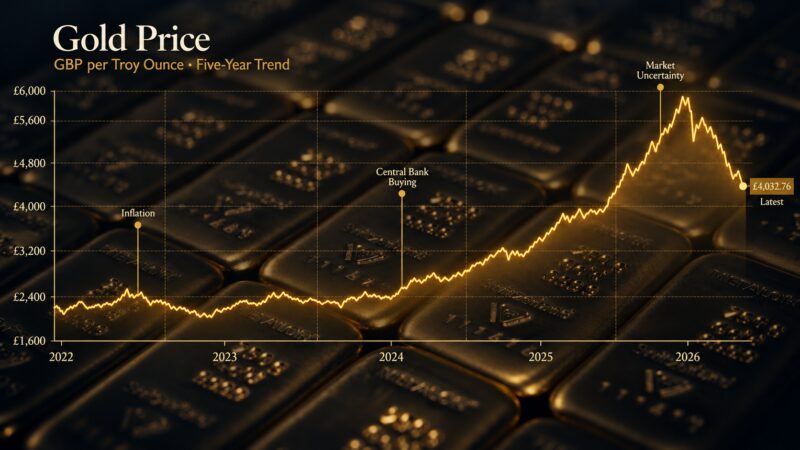
Precious metals are commonly priced internationally in US dollars. For UK buyers and sellers, the exchange rate between sterling and the dollar therefore matters.
Even if the dollar price of gold remains relatively stable, its value in pounds may rise if sterling weakens against the dollar. Equally, a stronger pound can reduce the sterling price without any significant change in the international gold market.
This is why UK investors should consider both the underlying metal price and currency movements when assessing performance.
What Influences Precious-Metal Prices?
There is no single factor that determines whether precious-metal prices rise or fall. Several forces interact across global markets.
Supply and Demand
Mining production, recycling, investment purchases, jewellery manufacturing and industrial consumption all contribute to the balance between supply and demand.
Gold demand is influenced strongly by investment, jewellery and central-bank activity. Silver, platinum and palladium also have substantial industrial uses, meaning their prices can be affected by changes in manufacturing, automotive production, electronics and renewable-energy technologies.
Supply disruptions, declining mine output or increased demand can place upward pressure on prices. The opposite conditions may place downward pressure on them.
Interest Rates and Inflation Expectations
Precious metals do not pay interest or dividends. When interest rates and inflation-adjusted bond yields are high, income-producing assets may appear more attractive by comparison. When real yields fall, the relative appeal of holding gold may improve.
Gold is often described as an inflation hedge, but the relationship is not automatic. Prices can fall during inflationary periods or rise when inflation is subdued. Market expectations, interest rates and confidence in currencies frequently matter as much as the published inflation figure itself.
Economic and Geopolitical Uncertainty
Financial instability, international conflict and concerns about economic growth can increase demand for assets perceived as stores of value.
Gold has historically attracted particular attention during periods of uncertainty, but this does not guarantee that its price will rise during every crisis. Investors may initially sell liquid assets—including precious metals—when they need to raise cash quickly.
Central-Bank Activity
Central banks hold gold as part of their official reserves. Significant changes in central-bank purchasing or selling can influence demand and wider market sentiment.
This factor is particularly relevant to gold. Silver, platinum and palladium are driven more heavily by a combination of investment demand and industrial consumption.
Futures, Funds and Market Sentiment
Precious metals are traded through physical markets, futures contracts, exchange-traded products and other financial instruments. These markets contribute to price discovery and allow participants to manage risk, but they can also increase short-term volatility.
Economic announcements, changes in investor positioning and unexpected news can therefore move prices rapidly—even before physical supply or demand has materially changed.
Why Physical Bullion Costs More Than Spot
A dealer cannot usually sell a finished coin or bar at the raw spot price. Physical bullion must be refined, manufactured, tested, transported, insured, stored and distributed.
The retail price may therefore include:
- The underlying value of the metal
- Refining and manufacturing costs
- Mint or brand premiums
- Wholesale and dealer margins
- Insurance, secure handling and delivery
- Product availability and market demand
- Any applicable taxes
Smaller products generally carry a higher percentage premium because manufacturing and handling costs are spread across less metal. A single one-ounce coin, for example, will usually cost more per ounce than a larger bar.
Certain limited, collectable or difficult-to-source products may also command premiums that are not based solely on their metal content.
Why Premiums Change
Premiums are not fixed. During periods of unusually strong retail demand, popular coins and bars can become scarce even when adequate metal exists within the wider wholesale market.
This can cause physical premiums to rise independently of the spot price. When availability improves or demand slows, premiums may fall again.
For this reason, two bullion products containing the same amount of metal may have noticeably different purchase prices.
Understanding Buy and Sell Prices
Dealers normally quote two different prices:
- The selling price is the amount a customer pays to purchase the product.
- The buy-back price is the amount the dealer offers when purchasing it from the customer.
The difference is commonly called the spread. It helps cover testing, administration, market exposure, secure handling and the cost of reselling or refining the metal.
Buy-back values can also depend on the product’s weight, purity, condition, quantity, authenticity and current resale demand. A widely recognised bullion coin may be priced differently from an unusual bar, damaged item or piece of unhallmarked jewellery.
For scrap gold and jewellery, the valuation is usually based primarily on confirmed purity, fine-metal weight and the current market price rather than the item’s original retail cost.
How to Compare Precious-Metal Quotes Properly
When comparing prices, do not look only at the headline figure. Check:
- Whether the price is live or indicative
- The weight and purity of the product
- The premium above the underlying metal value
- Whether VAT or other charges apply
- Delivery, insurance or storage costs
- The dealer’s buy-back terms
- How long the quoted price remains valid
A competitive purchase price is important, but transparency, accurate testing, product authenticity and a clear route for selling in the future also matter.
The Price Is Only One Part of the Decision
Nobody can predict precious-metal prices with certainty. Gold and other metals can rise or fall, sometimes sharply, and the factors influencing them frequently change.
Understanding how spot prices, exchange rates, product premiums and buy-back spreads work allows buyers and sellers to make better comparisons and avoid confusing the metal’s headline price with the value of a specific physical product.
At KNIGHTS Bullion, we provide transparent, market-led pricing and straightforward guidance when buying or selling precious metals. Speak to our team if you would like to discuss current prices, available bullion products or the valuation of gold, silver, platinum or palladium.
This article is provided for general information only and does not constitute financial, investment, legal or tax advice. Precious-metal prices can fall as well as rise. Consider your personal circumstances and seek independent professional advice where appropriate.