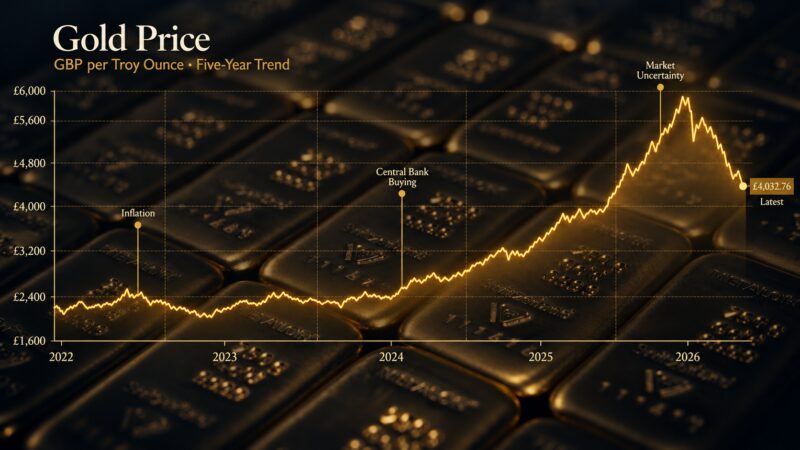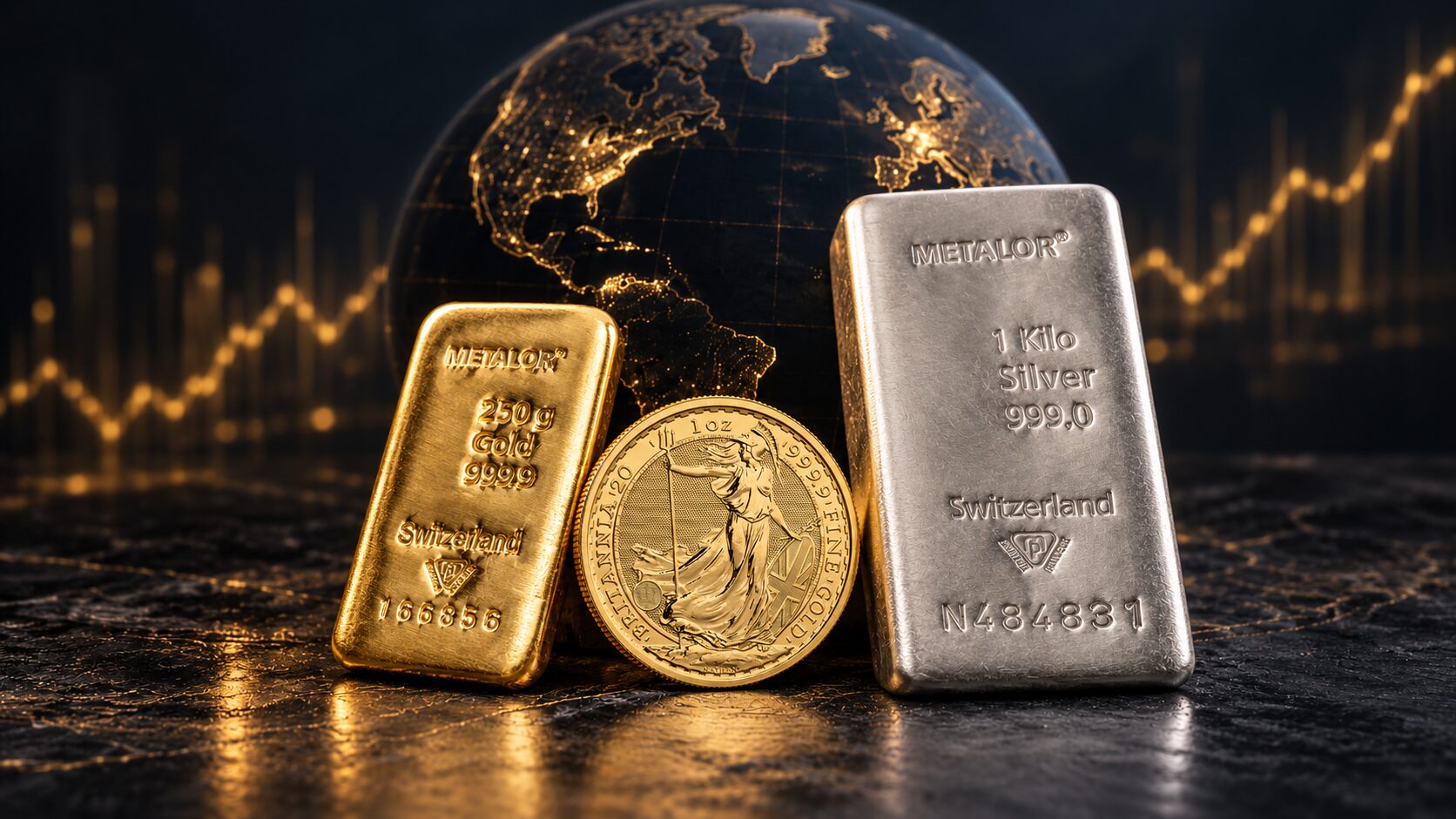
Gold and silver have been held for centuries as stores of value, forms of exchange and tangible assets. Today, their prices are determined in global markets and can respond rapidly to political developments, monetary policy, currency movements, investor sentiment and changes in industrial demand.
Global events do not produce a guaranteed response in precious-metal prices. Instead, they alter how investors, institutions, central banks and industrial users assess risk, growth, inflation and the future value of money.
Understanding these relationships can help investors interpret market movements without making decisions based on a single headline.
What actually moves precious-metal prices?
Like other traded assets, gold and silver prices ultimately reflect the balance between buyers and sellers. Global events influence that balance through several interconnected channels:
- Demand for perceived safe-haven assets
- Interest-rate and inflation expectations
- Movements in the US dollar and pound sterling
- Central-bank reserve decisions
- Investment flows and speculative positioning
- Industrial demand, particularly for silver
- Mine production, refining capacity and recycled supply
- Availability and premiums within the physical bullion market
The influence of each factor changes over time. A development that supports prices in one environment may have a smaller—or even opposite—effect in another.
1. Political uncertainty and geopolitical risk
Periods of political instability, military conflict, trade disruption or diplomatic tension can increase interest in gold. Investors may seek assets that are internationally recognised and are not issued by a particular company or government.
This is why gold is frequently described as a safe-haven asset. Central banks also hold gold for diversification, liquidity and, increasingly, as protection against geopolitical and financial risks.
However, geopolitical tension does not guarantee that gold will rise immediately. Markets often anticipate events before they happen, and other forces may outweigh safe-haven demand. A strengthening US dollar, rising real interest rates or a sudden need for investors to raise cash can place downward pressure on gold even during periods of uncertainty.
Silver may also benefit from precious-metal demand, but its response can be less predictable because of its substantial industrial use.
2. Interest rates and monetary policy
Physical bullion does not pay interest or generate income. Consequently, changes in interest rates can affect the relative attraction of holding gold and silver compared with cash or interest-bearing assets.
When inflation-adjusted, or “real,” interest rates rise, holding non-yielding bullion can become less attractive. When real yields fall—or markets expect interest-rate reductions—the opportunity cost of holding precious metals may decrease.
This relationship is important, but it is not automatic. Investors also consider why rates are changing. A rate reduction caused by weakening economic conditions may support safe-haven demand, while a rate reduction accompanied by improving confidence could produce a different response.
Markets are forward-looking, so gold and silver prices frequently move when expectations change rather than when an official interest-rate decision is finally announced.
3. Inflation and confidence in currencies
Gold is often considered a potential hedge against inflation and currency depreciation over the long term. However, it does not track consumer-price inflation consistently from month to month or year to year.
During some inflationary periods, higher interest rates can place pressure on gold. At other times, concerns about persistent inflation, government debt or the purchasing power of currencies may increase demand for tangible assets.
Investors should therefore avoid assuming that a higher inflation figure will automatically produce a higher gold price.
4. Why sterling matters to UK investors
International gold and silver markets are heavily influenced by prices quoted in US dollars, but UK customers buy and sell bullion in pounds sterling.
This means the sterling value of precious metals is affected by two moving components:
- The international metal price
- The exchange rate between sterling and the US dollar
If sterling weakens against the dollar, the UK price of gold may rise even when the dollar gold price changes very little. Conversely, a stronger pound can reduce or offset part of an increase in the international price.
For UK investors, it is therefore important to consider both the underlying metal market and currency movements.
5. Central-bank activity
Central-bank decisions are particularly relevant to gold. Gold forms part of the official reserves held by many countries and may be used to diversify reserve assets, manage risk and reduce dependence on other currencies or government liabilities.
Sustained central-bank buying can provide an important source of demand and may influence wider investor confidence. Sales can add supply to the market, but they do not automatically cause prices to fall. The size, timing and transparency of the transaction—as well as whether it was already expected—can all affect the market response.
Central-bank reserve activity is much more directly relevant to gold than to silver. It is therefore misleading to apply the same central-bank argument equally to both metals.
6. Silver’s industrial role
Silver is both a precious metal and an industrial material. It is used in areas including electronics, solar technology, automotive applications and other electrical products.
This gives silver a different demand profile from gold. Expectations of economic growth, manufacturing activity and technological demand can all influence its price.
During periods of financial uncertainty, investment demand may support silver. However, if the same event creates fears of recession or falling industrial production, those concerns can place pressure on silver demand. This helps explain why silver can be more volatile than gold and why the two metals do not always move by the same amount—or in the same direction.
7. Market sentiment, investment flows and speculation
Short-term precious-metal prices are influenced by professional traders, futures markets, exchange-traded products and large institutional flows, as well as by demand for physical coins and bars.
News reports can cause traders to adjust positions quickly. If many market participants attempt to make the same adjustment simultaneously, prices can move sharply and sometimes reverse just as quickly.
This does not necessarily indicate a permanent change in the long-term case for holding precious metals. It may instead reflect positioning, profit-taking, changing expectations or short-term liquidity requirements.
For this reason, a single day’s price movement rarely provides a complete explanation of what is happening in the wider market.
8. The difference between the metal price and physical bullion
The international benchmark or spot price is not necessarily the final price paid for a physical coin or bar.
Physical bullion prices may also reflect:
- The type, size and manufacturer of the product
- Minting or fabrication costs
- Product availability
- Market demand for particular coins or bars
- Delivery, insurance and secure handling
- The quantity being purchased
- The dealer’s premium or buyback margin
During periods of unusually strong demand or disrupted supply, premiums on physical products can rise even if the underlying metal price has changed relatively little.
This is why experienced bullion buyers compare more than the headline spot price. Product premiums, authenticity, fulfilment, storage, service and the eventual route to resale all matter.
What should investors take from global events?
There is no reliable formula stating that a particular election, conflict, inflation announcement or interest-rate decision must cause gold or silver to move in one direction.
A more considered approach is to ask:
- How could this event affect inflation, interest rates or currencies?
- Is the development already reflected in market prices?
- Does it affect gold and silver differently?
- Is the price movement driven by long-term demand or short-term trading?
- Has the availability or premium of physical bullion also changed?
- How does the purchase fit the investor’s objectives, time horizon and need for liquidity?
Precious metals can play a role within a diversified strategy, but their prices can fall as well as rise. Decisions should be based on individual circumstances rather than short-term market predictions.
Speak to a bullion broker
KNIGHTS helps private clients source, store and sell physical gold and silver through a personal, consultation-led service.
Our team can explain available products, premiums, secure delivery and storage options, as well as the practical route to selling bullion in the future.
Speak to a KNIGHTS bullion broker to discuss your requirements.
Frequently asked questions
Does war always cause the gold price to rise?
No. Geopolitical risk can increase safe-haven demand, but the final market response also depends on interest rates, currencies, investor positioning and whether the event was already anticipated.
Do gold and silver respond to global events in the same way?
Not necessarily. Gold is strongly influenced by investment and central-bank demand. Silver is also affected by industrial activity, which can make it more sensitive to expectations for global growth and manufacturing.
Why can the UK gold price move differently from the US price?
UK investors transact in pounds sterling, while global precious-metal markets are strongly influenced by US-dollar pricing. Movements in the sterling-dollar exchange rate can amplify or offset changes in the international metal price.
Do lower interest rates always increase gold prices?
No. Lower real yields can make non-yielding gold relatively more attractive, but markets consider the reason for the rate change, future expectations and other economic conditions.
Why is the price of a physical coin higher than the metal price?
Physical coins and bars can include premiums reflecting fabrication, product availability, insurance, delivery, handling and market demand. Premiums vary between products and can change independently of the underlying metal price.
Sources and further reading
- LBMA Gold Price
- European Central Bank: Gold demand, the official sector and geopolitics
- World Gold Council: Gold Outlook 2026
- World Bank: Gold amid economic and geopolitical uncertainty
- The Silver Institute: World Silver Survey 2026
This article is provided for general information and educational purposes only. It does not constitute financial, investment, tax or legal advice. Precious-metal prices can fall as well as rise, and you may receive less than you originally paid. Consider your own circumstances and seek independent professional advice where appropriate.